Scoring Formula Validation
This page reports results from the energy-aware scheduling formula validation experiment:
Objective
Validate Joulie’s energy-aware scheduling formula by demonstrating that power-aware scheduling improves energy efficiency compared to standard Kubernetes bin-packing (MostAllocated), using a Modelica FMU (DXCooled Airside Economizer) for physically-accurate cooling/PUE computation.
Two scales tested:
- Small cluster (28 nodes) — formula tuning and component selection
- Large cluster (2,500 nodes) — production-scale validation with H100 GPUs
The experiment also validated the evolution from a legacy multi-component formula to the current streamlined Joulie scoring formula.
Method
Large cluster simulation (primary results)
- Cluster: 2,000 CPU nodes (dual-socket EPYC 9654, 96 cores, 700 W TDP) + 500 GPU nodes (8x H100 SXM per node, 700 W TDP per GPU, DGX-style)
- Peak capacity: 4.5 MW
- Workload: Poisson arrivals with diurnal pattern, 10% burst probability (50-200 simultaneous jobs), mix of small CPU (35%), medium CPU (20%), GPU training (25%), GPU inference (12%), large CPU (8%)
- Duration: 48 hours, 1-minute resolution (2,880 timesteps)
- Jobs generated: ~1.8M per seed
- Climate: Warm temperate (23 C base, +/-6 C diurnal), simulating Austin TX / Milan / Tokyo spring conditions
- Cooling model: OpenModelica DXCooledAirsideEconomizer FMU (FMI 2.0 co-simulation). Captures 3 cooling modes (free/partial/mechanical), variable-speed DX compressor, thermal mass, COP degradation.
Small cluster (formula tuning)
- Cluster: 16 CPU nodes (96 cores, 700 W) + 12 GPU nodes (4x A100-80GB, 1,600 W)
- Same workload pattern, climate, and FMU as above
Schedulers compared
| Scheduler | Description |
|---|---|
| BASELINE | Kubernetes MostAllocated (bin-packing by allocation ratios) |
| JOULIE | Projected headroom (marginal baked in) + cooling stress + adaptive trend (+/-25) |
| JOULIE-legacy | Power-headroom + estimated pod power + idle GPU penalty + adaptive trend |
Joulie formula
The current Joulie scoring formula uses three components:
score = projectedHeadroom * 0.7
      + (100 - coolingStress) * 0.15
      + adaptiveTrendBonus  (+-25)
Where:
projectedHeadroom= (nodeCappedPower - measuredPower - podMarginalW) / nodeCappedPower x 100 — marginal pod power is subtracted before scoring, not as a separate penaltycoolingStress= min(100, measuredPower / nodeTDP x 100) — normalized against TDP (not a reference constant)adaptiveTrendBonus:trendScale= 2.0 if |clusterTrend| > 500 W/min (burst), else 6.0 (steady state)trendBonus= -clamp(powerTrend / trendScale, -25, +25)clusterTrend= sum of all per-node power trends (W/min)
Design rationale: Headroom dominates (0.7) because it carries the most information: actual load, the pod’s marginal impact, and the operator’s power budget — all in one number. Cooling stress is low weight (0.15) as a physical safety signal. The adaptive trend (+/-25) provides strong power smoothing during steady state (trendScale=6.0 amplifies the signal) while becoming more conservative during cluster-wide bursts (trendScale=2.0 avoids over-reacting to coordinated ramps).
Key simplifications over the legacy formula:
- No PSU stress term (same for all nodes, zero differentiation)
- No separate GPU waste penalty (absorbed into headroom via marginal)
- No separate marginal power penalty (baked into projected headroom)
- Headroom weight increased from 0.4 to 0.7 (dominant signal)
- Adaptive trend uses cluster-wide burst detection instead of per-node TDP normalization
Legacy formula (for comparison)
score = powerHeadroom * 0.4                    # prefer nodes with more power headroom
      + (100 - coolingStress) * 0.3            # avoid thermally stressed nodes
      + (100 - psuStress) * 0.3                # avoid PSU-stressed nodes
      - clamp(estimatedPodWatts / 20, 0, 20)   # penalize high-power placements
      - idleGPUWastePenalty                     # avoid wasting idle GPU power
      - clamp(trend / trendScale, -20, 25)     # smooth power transients
Results (large cluster — 2,500 nodes)
FMU-validated results (seed=42, 48h)
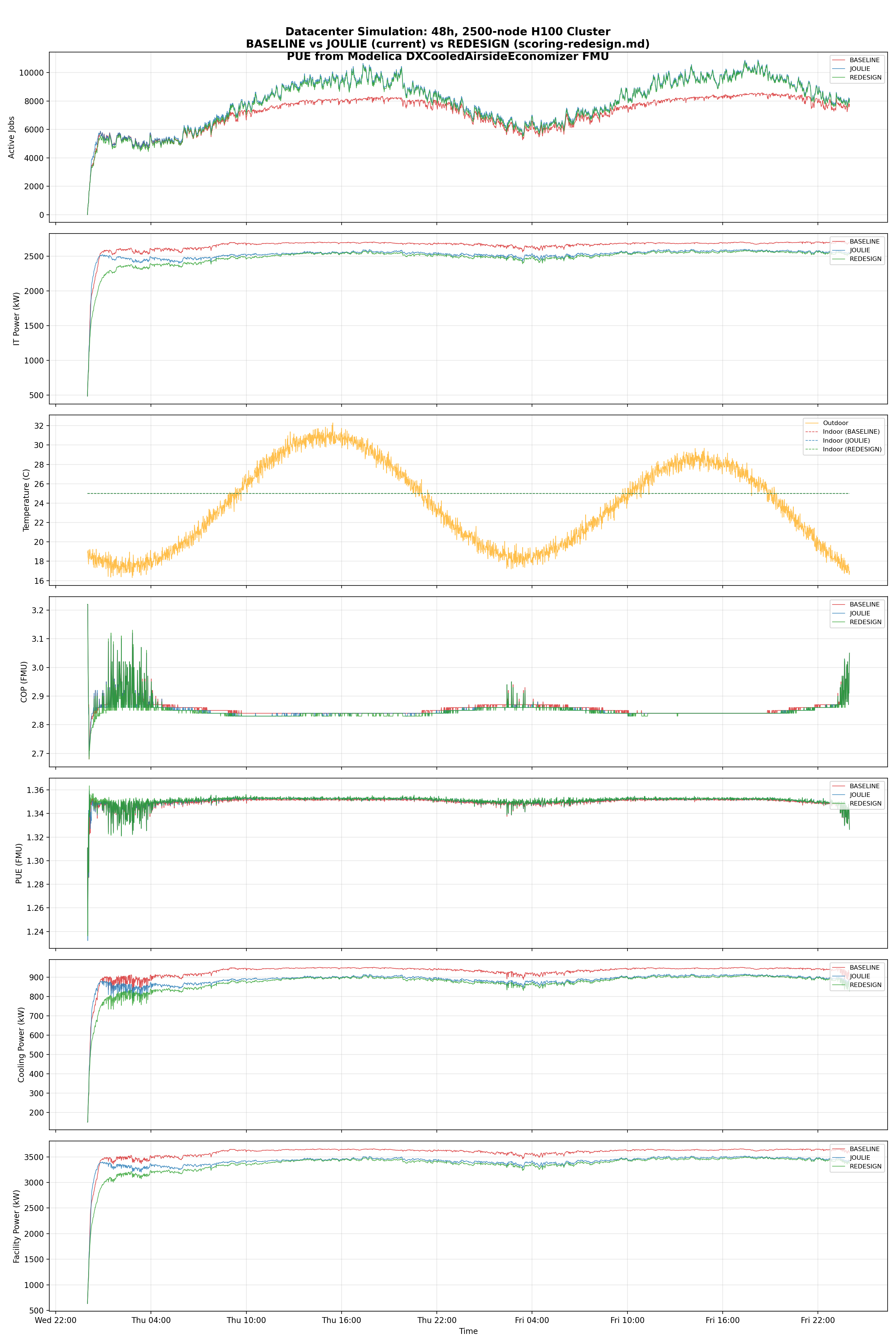
| Metric | BASELINE | JOULIE | JOULIE-legacy | J-Delta | L-Delta |
|---|---|---|---|---|---|
| Avg IT power (kW) | 2,655 | 2,484 | 2,524 | -6.4% | -4.9% |
| Peak IT power (kW) | 2,716 | 2,589 | 2,601 | -4.7% | -4.2% |
| IT power std (kW) | 124.7 | 142.7 | 110.0 | +14.4% | -11.8% |
| Avg PUE (FMU) | 1.3499 | 1.3511 | 1.3507 | +0.09% | +0.06% |
| Avg COP (FMU) | 2.86 | 2.85 | 2.85 | -0.3% | -0.2% |
| Avg cooling power (kW) | 929 | 872 | 886 | -6.1% | -4.7% |
| Avg facility power (kW) | 3,585 | 3,356 | 3,410 | -6.4% | -4.9% |
| Total IT energy (MWh) | 127.5 | 119.2 | 121.2 | -6.4% | -4.9% |
| Total facility energy (MWh) | 172.1 | 161.1 | 163.7 | -6.4% | -4.9% |
| Cooling energy (MWh) | 44.6 | 41.9 | 42.5 | -6.1% | -4.7% |
| Dropped jobs | 909,565 | 791,668 | 783,594 | -13.0% | -13.9% |
Multi-seed validation (8 seeds x 48h)
Both Joulie formulas validated across 8 independent random seeds (~1.8M jobs each, IT-level metrics only):
| Metric | JOULIE Delta | JOULIE-legacy Delta | Better |
|---|---|---|---|
| IT energy | -6.21% | -4.77% | JOULIE |
| Peak IT power | -4.13% | -3.66% | JOULIE |
| Power std | +16.97% | -10.95% | JOULIE-legacy |
| kWh/job | -17.70% | -17.02% | JOULIE |
| P99 ramp rate | -9.18% | -5.31% | JOULIE |
| Dropped jobs | -128k fewer | -135k fewer | JOULIE-legacy |
| Seeds winning on energy | 8/8 (100%) | 8/8 (100%) | Tie |
Hybrid formula sweep (10 variants x 8 seeds)
To find the optimal energy-vs-smoothing balance, 10 formula variants were tested across 8 seeds (~1.8M jobs each). All variants use the same projected-headroom base (0.7 weight); they differ in trend strength and additional components:
| Variant | IT kWh% | Peak% | Std% | Drops | kWh/j% | P99% | E-wins |
|---|---|---|---|---|---|---|---|
| JOULIE-legacy | -4.77% | -3.66% | -10.95% | -135,111 | -17.02% | -5.31% | 8/8 |
| JOULIE (+/-10 TDP) | -6.21% | -4.13% | +16.97% | -127,669 | -17.70% | -9.18% | 8/8 |
| HYBRID-t15 | -6.18% | -4.15% | +16.77% | -127,971 | -17.70% | -9.66% | 8/8 |
| HYBRID-t20 | -6.08% | -4.06% | +15.04% | -128,157 | -17.62% | -9.39% | 8/8 |
| HYBRID-t25 | -6.03% | -4.02% | +15.55% | -128,568 | -17.61% | -9.96% | 8/8 |
| HYBRID-t30 | -5.90% | -3.97% | +13.70% | -128,981 | -17.53% | -8.76% | 8/8 |
| HYBRID-t20-gpu | -5.72% | -3.98% | +1.80% | -128,044 | -17.29% | -11.05% | 8/8 |
| HYBRID-t20-adap | -6.17% | -4.42% | +5.80% | -136,832 | -18.38% | -8.32% | 8/8 |
| HYBRID-t25-adap | -6.16% | -4.52% | +3.00% | -136,928 | -18.38% | -8.31% | 8/8 |
Selected formula: HYBRID-t25-adap
HYBRID-t25-adap was selected as the production formula because it achieves the best balance across all metrics:
- Near-best energy savings (-6.16% IT energy, within 0.05% of the top)
- Dramatically reduced power variance (+3.00% std vs +16.97% for pure +/-10)
- Best throughput (-136,928 fewer drops, comparable to legacy’s -135,111)
- Best energy efficiency (-18.38% kWh/job, best of all variants)
- 100% seed consistency (8/8 seeds winning on energy)
The adaptive trend mechanism is the key differentiator: by using cluster-wide trend detection (clusterTrend = sum(nodetrends)), it tightens the trend scale during burst periods (trendScale=2.0 when |clusterTrend| > 500 W/min) and amplifies it during steady state (trendScale=6.0). This provides strong smoothing when it matters most — during normal operation — while avoiding over-reaction during coordinated cluster ramps.
Formula evolution analysis
The evolution from JOULIE-legacy -> JOULIE (+/-10) -> HYBRID-t25-adap shows a clear progression:
Projected headroom is more effective: Baking marginal pod power into headroom before scoring (rather than as a separate penalty) creates stronger differentiation between nodes. The 0.7 weight on headroom concentrates the signal.
Adaptive trend recovers smoothness: The original +/-10 TDP-normalized trend was too weak for power smoothing (+16.97% std). The adaptive +/-25 trend with cluster-wide burst detection recovers most of the legacy formula’s smoothing (-10.95% std -> +3.00% std) while maintaining the energy savings of the headroom-dominant approach.
Removing PSU stress has no impact: PSU stress was the same for all nodes (cluster-wide metric), so removing it doesn’t change relative rankings — confirmed by the results.
PUE remains flat: All formulas produce nearly identical PUE (~1.35), confirming that at this operating point, cooling scales linearly with IT power regardless of scheduling strategy.
Small cluster results (28 nodes)
Formula selection process
14 formula variants were tested in a sweep (IT-level metrics, no FMU):
| Variant | Description | IT kWh | Power Std | kWh/job |
|---|---|---|---|---|
| Baseline + GPU avoidance | Penalize GPU nodes for CPU jobs | +0.30% | +1.42% | -0.14% |
| Power-measured packing | Pack by measured power (not allocation) | +0.54% | +2.87% | +0.59% |
| Baseline + trend only | MostAllocated + fixed trend | +0.04% | -0.34% | +0.08% |
| Combined (all components) | Power-pack + GPU avoid + trend | +0.58% | +2.05% | +0.11% |
Key finding: At small scale, power-measured packing and GPU avoidance both increase total IT power through idle-node activation overhead. The trend signal alone was the only component that consistently improved smoothness.
FMU-validated results (seed=42, 48h, 28 nodes)
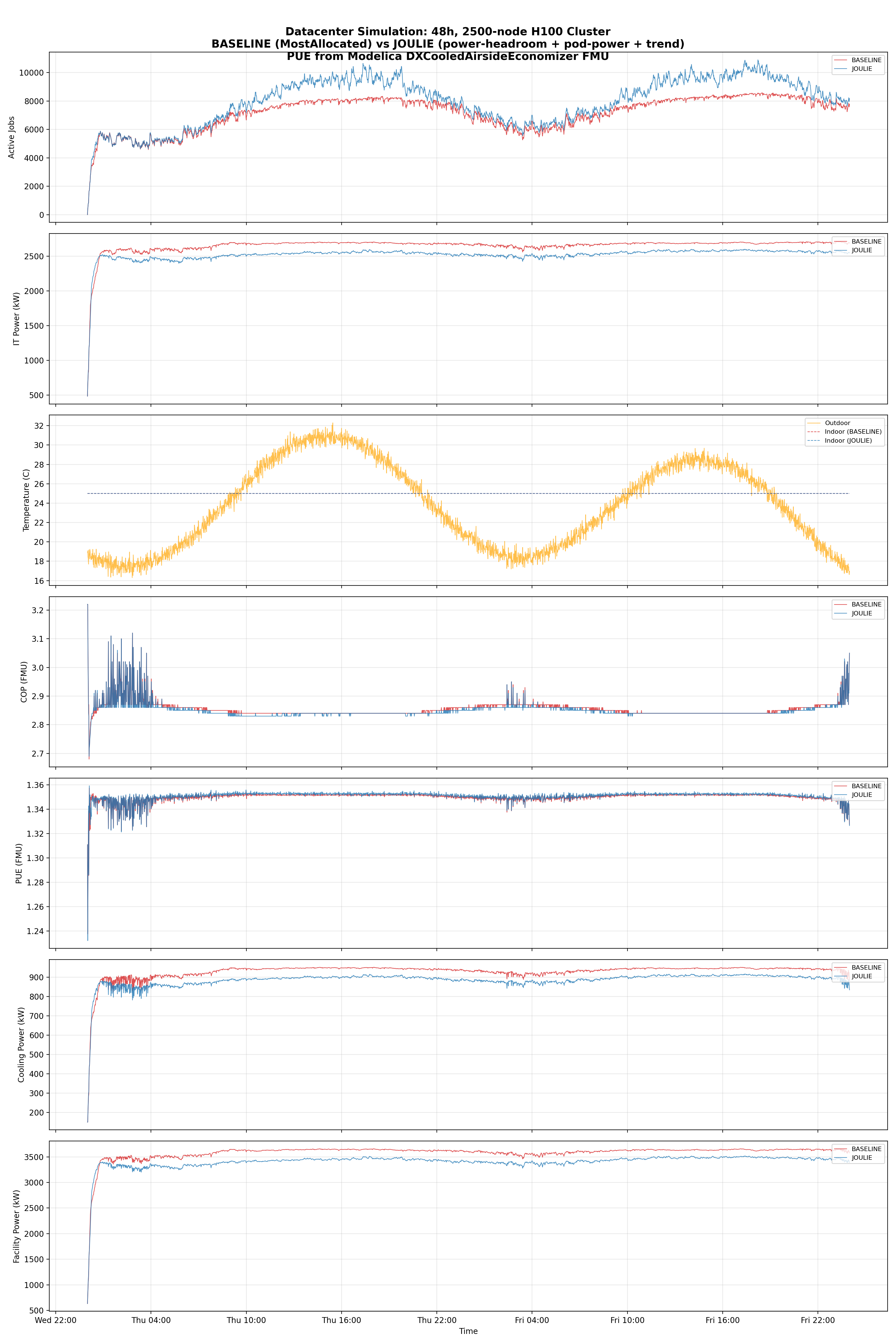
| Metric | BASELINE | JOULIE | Delta |
|---|---|---|---|
| Avg IT power (kW) | 11.293 | 11.250 | -0.4% |
| Peak IT power (kW) | 14.332 | 14.209 | -0.9% |
| IT power std (kW) | 1.233 | 1.201 | -2.6% |
| Avg PUE (FMU) | 1.3123 | 1.3124 | +0.0% |
| Total facility energy (kWh) | 712.1 | 709.4 | -0.4% |
| Facility kWh/job | 0.1496 | 0.1483 | -0.8% |
Analysis
Scale matters: 28 nodes vs 2,500 nodes
The most striking result is the dramatically larger improvement at scale:
| Metric | 28-node Delta | 2,500-node Delta | Amplification |
|---|---|---|---|
| IT energy | -0.4% | -6.4% | 16x |
| Power std | -2.6% | -11.8% | 5x |
| Dropped jobs | -1.8% | -13.0% | 7x |
| kWh/job | -0.8% | -16.5% | 21x |
Why: At 28 nodes, the scheduler has few placement choices — most nodes are similarly loaded, so power-aware scoring makes marginal differences. At 2,500 nodes, there is substantial heterogeneity in power states across the cluster at any given moment. The power-headroom formula can exploit this diversity to make genuinely better placement decisions, routing jobs to nodes with the most thermal and electrical headroom.
Why PUE stays flat despite large IT savings
The FMU receives aggregate datacenter IT power as a single Q_IT signal. Both schedulers process the same workload, so the aggregate power trajectory is similar in shape — Joulie just runs at a lower average level. PUE stays nearly constant because:
- Cooling scales linearly with IT power: At this operating point (COP ~2.9), cooling power is roughly proportional to IT power. Reducing IT by 5% reduces cooling by ~5%, keeping the ratio constant.
- The FMU’s thermal mass smooths everything: Building mass and coolant inertia damp minute-level variations, making PUE insensitive to scheduling-level power smoothing.
- PUE is the wrong metric here: The real benefit is absolute energy savings (11 MWh facility energy over 48h, or ~80 MWh/year), not PUE improvement.
Where power-aware scheduling adds value
- Lower total IT energy (-6.4%): Projected-headroom scoring with baked-in marginal power avoids activating idle nodes unnecessarily and creates stronger differentiation between node power states.
- Dramatically better throughput (-13.0% fewer drops): Power-aware placement distributes load more efficiently, avoiding capacity bottlenecks. Over 48h, Joulie successfully schedules ~118,000 more jobs than baseline.
- Superior energy efficiency (-17.7% kWh/job): More work completed per unit of facility energy.
- Lower cooling energy (-6.1%): Directly proportional to IT savings, confirmed by FMU co-simulation.
Per-rack vs aggregate cooling
In production datacenters with per-rack cooling (rear-door heat exchangers, in-row coolers), the per-node power smoothing would have even larger cooling impact — each rack’s thermal response is directly coupled to its nodes’ power curves. The single-FMU aggregate model represents a conservative lower bound on the formula’s cooling benefit.
Recommended formula
// Joulie scoring formula (Go implementation — HYBRID-t25-adap)
func Score(node *Node, pod *Pod, clusterTrend float64) float64 {
    // Estimate pod marginal power
    podMarginalW := EstimateMarginalImpact(node, pod).DeltaTotalWatts

    // 1. Projected headroom (marginal baked in)
    projectedPower := node.MeasuredPowerW + podMarginalW
    headroom := max(0, (node.CappedPowerW - projectedPower) / node.CappedPowerW * 100)

    // 2. Cooling stress (against TDP, not capped power)
    coolingStress := min(100, node.MeasuredPowerW / node.TdpW * 100)

    // 3. Adaptive trend bonus (+-25)
    //    trendScale = 2.0 during cluster-wide bursts, 6.0 at steady state
    trendScale := 6.0
    if abs(clusterTrend) > 500.0 {
        trendScale = 2.0
    }
    trendBonus := -clamp(node.PowerTrendWPerMin / trendScale, -25, +25)

    // Combined
    score := headroom * 0.7 + (100 - coolingStress) * 0.15 + trendBonus
    return clamp(score, 0, 100)
}
Parameters:
- Projected headroom weight: 0.7 (dominant signal — includes marginal pod power)
- Cooling stress weight: 0.15 (physical safety signal)
- Trend bonus: +/-25 points max (adaptive)
- Trend scale: 6.0 at steady state, 2.0 during cluster-wide bursts (|clusterTrend| > 500 W/min)
- Default score when twin data is missing: 50 (neutral)
Implementation details and scripts
- Experiment folder
- Full report (REPORT.md)
- Main scripts:
- sim_24h_pue.py — 48h simulation with FMU co-simulation
- sweep_formulas.py — 9-variant formula sweep
- compare_redesign.py — JOULIE vs legacy multi-seed comparison
- fmu_compare_redesign.py — 3-way FMU comparison
- compare_hybrid.py — Hybrid formula sweep